
On Friday, August 21, 2026, President Trump announced on Truth Social that “for the next 90 days, the United States will allow up to 300,000 metric tons of product for ground beef to be imported with no out of quota tariff,” adding: “We have a commitment that this beef will be sold at 25 percent below current market prices.” What the announcement did not say is which countries would ship the beef. Asked directly, Trump first answered “I don't want to say which countries, but there are a few countries” — then later named one: Argentina. Four days later, no implementing document exists. But the tariff being waived only punishes a small set of exporters, and following that math leads to a short, specific list of likely beneficiaries. This article lays out what is documented, what is inference, and what to watch for next. For the full backstory — the shrinking herd, the record prices, the screwworm border closures, and two years of tariff whiplash that led here — see the companion timeline: American Beef, January 2024 – August 2026.
What Was Announced — and What Exists on Paper
As of August 25, the entire plan consists of the Truth Social post and official statements around it. A White House official said foreign beef exporters had agreed to pass a 25% discount “along to American consumers” in exchange for tariff relief, and that an executive order would be signed “within the next two weeks.” Agriculture Secretary Brooke Rollins said the same day that the plan was “still under discussion” and was being finalized by U.S. Trade Representative Jamieson Greer. No proclamation, executive order, Federal Register notice, USTR notice, or Customs and Border Protection guidance implementing the action had been published — and no exporting government or industry association has confirmed participating in the price pledge.
The volume is not small. Three hundred thousand tonnes is roughly 661 million pounds: about 11% of forecast 2026 U.S. beef imports, about 2% of total domestic beef supply, and roughly half of all U.S. beef exports so far this year. Economists at Southern Ag Today estimate that if the volume lands in the fourth quarter, it would raise Q4 beef imports by about 51%. Cattle futures fell as much as 2.4% on the announcement.
The political pressure behind the plan is the price tag. Beef and veal entered 2026 up 16.4% year-over-year in the CPI — the hottest category in the grocery store — and the records kept coming: the all-fresh retail beef average hit $9.64/lb in April, and BLS lean/extra-lean ground beef set a record $8.65/lb in June. The supply math offers no quick relief: the January 1, 2026 cattle inventory came in at 86.2 million head, a 75-year low, with beef cows the fewest since 1961. July's mid-year count ticked up slightly — the first stabilization signal of the cycle — but a biological rebuild takes years, and American shoppers are feeling it now. The month-by-month numbers at every level of the market — retail ground beef, wholesale boxed beef, cash cattle, and production — are charted on the companion data page: Beef Prices & Supply, January 2024 – Present.
- Oct 19–22, 2025 — With cattle futures at record highs, Trump says the U.S. “would buy some beef from Argentina” and tells ranchers they “have to get their prices down.” Feeder futures drop $9.25 in a day; the NCBA and rancher groups revolt. Within weeks, the administration exempts beef from its reciprocal tariffs and removes the 40% tariff it had put on Brazilian beef in August.
- Feb 6, 2026 — A presidential proclamation, “Ensuring Affordable Beef for the American Consumer,” quadruples Argentina's duty-free beef access from 20,000t to 100,000t, allocated in quarterly 20,000t tranches (CBP Quota Bulletin 26-223; CRS IN12687).
- May 2026 — Trump floats a similar suspension of the beef quota system, reported by the Wall Street Journal, then retreats after pushback from Congress and rancher groups.
- Aug 21, 2026 — The 300,000t, 90-day, no-out-of-quota-tariff announcement, with the “25% below market” pledge. Cattle futures drop; South American packer stocks jump.
- Aug 22, 2026 — In an unrelated but colliding trade fight, 50% U.S. tariffs on ~$27.6B of Canadian goods take effect; Canada promises dollar-for-dollar retaliation starting Sept 8. Canadian beef is outside the quota system and unaffected by the waiver either way.
- Aug 24, 2026 — The Douglas, Arizona cattle port reopens to Mexican live cattle (700 head/day initially) after a year-plus New World screwworm closure — a cattle story, not a quota story.
- Aug 25, 2026 — Rollins says the plan is “still under discussion”; the implementing order remains unpublished.
Follow the Tariff: Why the Quota Math Narrows the List
The United States imports beef under a tariff-rate quota (TRQ). Inside a country's quota, the tariff is trivial — about 4.4 cents per kilogram. Above it, the tariff jumps to 26.4% ad valorem. On beef valued around $7/kg, the American Farm Bureau Federation figures that gap is worth more than $1.80 per kilogram. Waiving the out-of-quota rate, therefore, is worth a fortune to exporters who are paying it — and worth nothing to exporters who aren't. That single fact sorts the world's beef suppliers into winners and bystanders.
Who pays the 26.4% rate today? Almost nobody except the users of the pooled “Other Countries” quota — chiefly Brazil, with Paraguay and Nicaragua behind it. That pool was cut from roughly 65,000t to 52,005t on January 1, 2026 (13,000t was reallocated to a new UK quota per a December 2025 USTR notice). The 2025 pool had filled in 17 days; the smaller 2026 pool filled within the first six days of January. Every Brazilian shipment since January 6 has paid the full 26.4% — and Brazil has still remained the largest or second-largest U.S. supplier all year, at roughly 324,000t (with-bone equivalent) in the first half of 2026. Its product mix is dominated by frozen boneless lean beef — exactly the grinding material this program targets. Uruguay is in a similar position by choice of product: about 78% of its U.S. placements already enter over-quota, paying the tariff.
Who doesn't pay it? Australia and New Zealand, which hold large country-specific quotas (Australia's is roughly 449,909t for 2026) that are only about two-thirds filled — the waiver is largely irrelevant to them. And Canada and Mexico ship entirely outside the quota system, so waiving an over-quota rate does literally nothing for them.
The Ranked Assessment
No official allocation exists. But combining the quota mechanics with trade data, market reactions, and the president's own words produces a clear ranking — offered here as inference, not documented fact:
- Tier 1 — Brazil (highest structural probability). The only major supplier locked out by the exact tariff being suspended. Record volumes despite paying 26.4% all year; a quota that filled in six days; and a push factor: China's three-year beef safeguard (55% over-quota tariff) is nearly full for Brazil — it passed 90% of its China quota by August 10 — making the U.S. the default outlet for displaced Brazilian product for the rest of the year. Brazil's political standing has been volatile but favorable when it counts: the administration hit Brazilian goods with ~50% tariffs in August 2025, removed them for beef that November, and exempted beef again from its July 2026 Section 301 action against Brazil — over objections from U.S. cattlemen's groups. As Beef Central reported, “Brazil will clearly be the biggest beneficiary under the measure, early Australian industry reaction suggests.”
- Tier 1 — Argentina (highest political probability, partially confirmed). The only country Trump has named — and the one he has been naming since October 2025, when he first floated buying Argentine beef to force prices down. The deepest administration relationship in the sector: the February proclamation quadrupling its quota, a $20 billion U.S. Treasury currency swap, and a broader trade framework backing President Javier Milei. Argentine exports to the U.S. are up roughly 111% year-over-year, and it had filled 72.5% of its permanent quota by August 3 — the highest fill rate of any beneficiary. Its additional benefit comes via over-quota trimmings once the 100,000t fills.
- Tier 2 — Uruguay, Paraguay, Nicaragua. Uruguay gains directly (78% of shipments already over-quota); Paraguay (+59% first-half growth) and Nicaragua (+40%) share Brazil's “Other Countries” pool at smaller scale.
- Tier 3 — Australia, New Zealand, Canada, Mexico. Documented disqualifiers for this specific action: unfilled quotas or no quota at all. Australia's exposure is competitive — cheaper Brazilian beef undercutting its U.S. market — not direct.
The stock market reached the same conclusion within hours. Shares of Brazilian packers MBRF Global Foods and Minerva jumped to their highest intraday levels since spring; JBS rose; Tyson Foods, the most U.S.-concentrated major packer, slipped. XP Investimentos called Minerva the likely biggest beneficiary among meatpackers; BTG Pactual called the decision “particularly negative for Tyson.” Investors, in other words, read the announcement as a transfer toward South American — especially Brazilian — suppliers.
The Pushback, and the Administration's Case
The domestic reaction was swift and unusually bipartisan in tone if not in motive. The three big cattle producer groups — the National Cattlemen's Beef Association, the U.S. Cattlemen's Association, and R-CALF USA — all condemned the plan, arguing that a flood of below-market imported trimmings undercuts American ranchers just as the herd sits at a 75-year low of 86.2 million head — and as packing capacity shrinks alongside it (Tyson alone has closed or moved to sell four beef plants in 2026). The same groups had objected a month earlier when beef was exempted from the Section 301 tariffs on Brazil. Republican senators from cattle states — Tim Sheehy of Montana, Deb Fischer and Pete Ricketts of Nebraska — pushed back publicly, as did Tom Cotton and Thom Tillis. Critics' statements pointedly named Brazil and Argentina as the pattern-setting recipients of administration tariff relief, alongside the reopening of the border to Mexican cattle.
The administration's counterargument is the consumer price tag. Ground beef is the highest-volume red meat in American grocery carts, retail prices have set records all year ($9.64/lb all-fresh in April; $8.65/lb for lean ground in June), and demand has refused to break — per-capita consumption in 2024 was the highest since 2009, and 2025 imports ran 20% above the prior year to backfill falling domestic production. The White House frames the deal as tariff relief purchased with an exporter-funded 25% discount “to be passed along to American consumers” — the same affordability logic it used for Argentina in February. Skeptics note a mechanical problem: exporters do not control U.S. retail prices, retailers do. It remains unknown whether the “25% below market” commitment applies to the import price, wholesale trim, or the grocery shelf, and no named exporter has publicly acknowledged making the pledge.
What Happens Next
Everything now waits on paper. The implementing executive order or proclamation is expected by early September, and its text settles the core question: an order suspending the out-of-quota rate for all countries rewards Brazil most by volume; an order allocating country-specific tranches — the template February's Argentina proclamation used — will name the winners outright. CBP typically publishes the country-specific mechanics alongside implementation, via CSMS messages and quota bulletins. After that, the empirical confirmation arrives in the data: weekly USDA “Imported Meat Passed for Entry” reports and monthly Census import figures will show within weeks which origins actually surge during the 90-day window.
There is also a live possibility the plan shrinks or dies. Trump floated essentially the same idea in May 2026 and abandoned it under rancher and Congressional pressure, and Rollins's “still under discussion” framing leaves the same exit open. The signals that would change the picture: an order naming only Argentina (demoting Brazil to an incidental beneficiary), an all-country suspension (elevating Australia's volume role), or a formal denial of the price pledge by Brazil's ABIEC or Argentina's Consorcio ABC (undercutting the “25% below market” premise). Until the order publishes, the honest answer to “whose beef is it?” remains: almost certainly Brazil and Argentina — on the evidence of the tariff itself, not on any official list.
Sources
- ABC News — Trump announces temporary pause on beef import tariffs (Aug 21, 2026)
- Drovers — deal to slash ground beef prices 25% sends markets lower (Aug 22, 2026)
- Congressional Research Service — IN12687, on the February 2026 Argentina beef proclamation
- U.S. Customs and Border Protection — quota bulletins, including 26-223 (Argentina tranches)
- Federal Register — December 2025 USTR notice reallocating 13,000t of the “Other Countries” pool to the UK
- NPR — 50% U.S. tariffs on Canadian goods take effect (Aug 22, 2026)
- Beef Central — Australian industry reaction: “Brazil will clearly be the biggest beneficiary” (Aug 2026)
- Bloomberg, via Energy Connects — packer stock moves on the announcement (Aug 21, 2026)
- American Farm Bureau Federation, via CNBC — in-quota vs. out-of-quota tariff math (May 2026)
- Southern Ag Today — estimate that 300,000t would raise Q4 imports ~51%
- ABC News — Trump's October 2025 Argentina beef remarks and rancher backlash
- White House — EO removing the 40% Brazil tariff on beef (Nov 2025)
- Capital Press — beef exempted from the Section 301 tariffs on Brazil (Jul 2026)
- Drovers — January 2026 cattle inventory: 86.2M head, a 75-year low
- American Farm Bureau — record $9.64/lb all-fresh retail beef (Apr 2026)
- BLS via FRED — ground beef average price series
- Oklahoma Farm Report — Tyson's 2026 beef plant closures
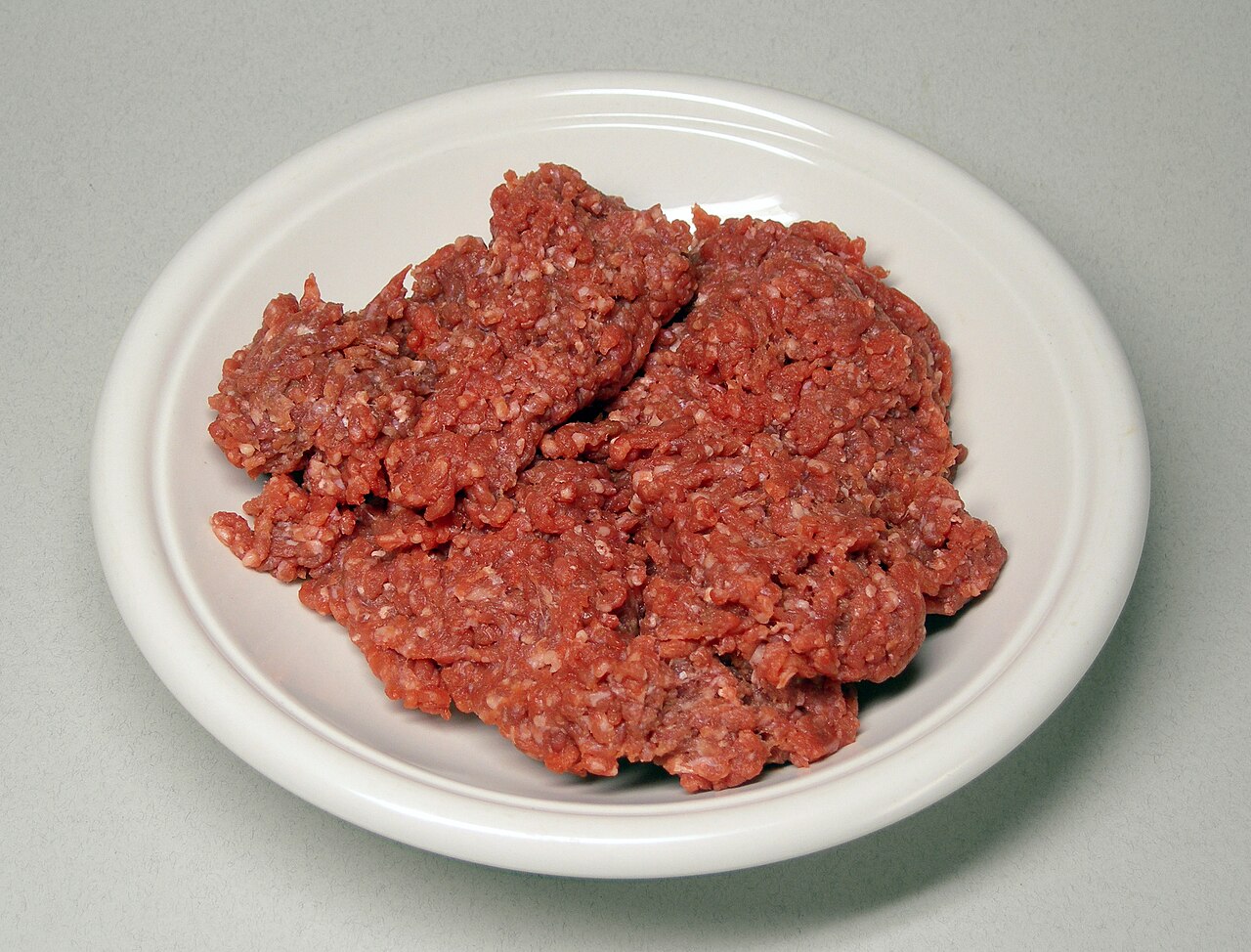
Image credits: raw ground beef — Rainer Zenz, CC BY-SA 3.0, via Wikimedia Commons.
Discussion (0)
Join the discussion. Pick a name and your party — that’s the whole signup. Comments are color-coded: Democrat Independent Republican. No links, no slurs — disagree like a citizen.
No comments yet — be the first.
Comments are the sole responsibility of their authors and do not reflect the views of CommonHouseParty.org. Party labels are self-declared and unverified — they describe what a commenter chose at signup, nothing more. Accounts are name-and-party only, so identity cannot be guaranteed. We may remove comments that contain links, slurs, personal attacks, or private information, and repeat abuse may be blocked. We log the IP address of every signup and comment for abuse prevention and moderation; these logs are not published. By posting, you grant us permission to display your comment on this page.